Thursday, September 3, 2015

Payoneer

If you’re a professional affiliate, buying traffic, getting paid, then turning around and buying traffic right back up again is your modus operandi. The ability to turn around and re-buy traffic as quickly as possible is the part where revenue generation can take a big hit. The challenge for affiliates is getting liquid access to their earnings. Easier said than done though.
It’s this particular problem that Payoneer, whose Master Card debit card solution we’ve covered in the past, has made into its house specialty and why it’s become a popular choice for international affiliates.

Need proof? How about $500M in yearly payments going through its systems, and a year-over-year growth rate in the past four years of 100%? No question that Payoneer’s offering has jumped the shark.
Affiliates typically receive their payments by way of wire transfer or check, directly into their local bank accounts, in their own countries. When they buy traffic, however, they usually need to make an international payment.
This moving of money back and forth is costly (fees can be upwards of $30 for wire transfers), and also time consuming (wire transfers take several days to make it to their destination).
With Payoneer, all users are Master Card debit card cardholders. This means that once funds are deposited into their accounts, users can immediately make standard credit card payments, or withdraw cash from ATMs. For affiliates, the real upside is that they can use their cards to pay for traffic they buy **without** the back and forth local-to-international money transfers.
Also, using Payoneer doesn’t require users to have bank accounts, and the cards can be reloaded within hours of funds being deposited in user accounts. And now with the newly launch local bank transfer service, Payoneer can transfer funds in the local currency of the user, as opposed to the currency they were paid in (typically USD). Local currency transfers are both cheaper ($6.95-9.95) and faster than a standard wire transfer. For international users residing in countries where banking systems are still lagging decades behind those of Western countries these are big deals.
The local bank transfer service is going to be gradually released to different countries and partners, so it will take a while to become available all over the globe (although that is decidedly the goal).
Payoneer’s value proposition hasn’t gone unnoticed. The company already has over a thousand partners making payments to hundreds of thousands of users. And with the signing of Direct Track, ~100,000 additional affiliates will be exposed to Payoneer’s solution.
Payonner is backed by Carmel Ventures and Greylock Partners.

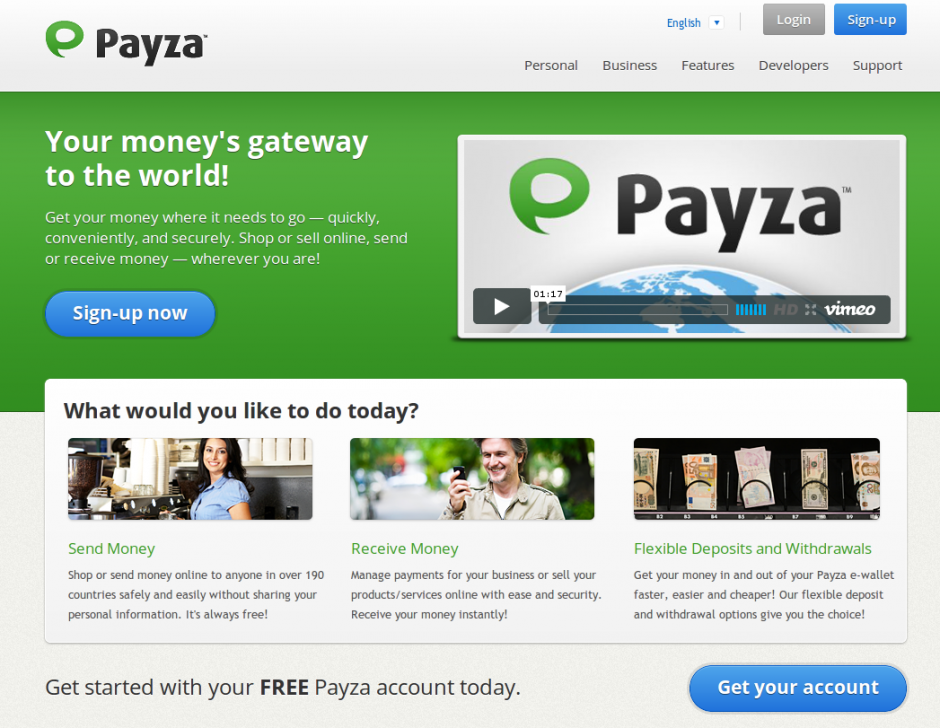
Payza

Payza already offers one of the fastest and most versatile way to send money online. With services in over 190 countries, Payza makes it easy to send money instantly to friends and loved ones almost anywhere in the world.
Last year we introduced Balance Top Up, giving members a way to instantly add funds to their account when they wanted to send money or pay a Payza merchant but didn’t have enough funds in their e-wallet. Our wide range of withdrawal options, including Bank Account, Bitcoin, and Credit Card withdrawals make it easy for you to access the money in your Payza account.
At Payza, we’re committed to creating the best possible user experience, and part of that means giving our members more choice. Now, when you Send Funds using Payza, you have the option to add the fees to your transaction instead of having your recipient pay the fees making it easier when you need to send a specific amount. You won’t have to calculate what amount of fees will be deducted, just enter the amount you want to send, select “I Pay“, and we’ll take care of the rest.


Legitimate businesses and hard-working individuals were the next targets. They too needed a means of transferring money across the world. With the emerging Asian markets offering cheap goods and services, they needed a way to pay them for their merchandise. PayPal or Dwollar could not offer their services in many counties due to local restrictions: Alertpay/ Payza found a way around them! The same methods were soon used on these new victims as had been used before. Emails were sent out citing a breach in their terms and conditions and as such, the accounts were frozen, pending the result of an ongoing enquiry. Many clients reported that they never saw their money again. Whilst the enquiry was in progress, the Patels would empty the accounts and reallocate the funds for their own benefit. Most small businesses and individuals could not afford to take legal action against such a large international company.
The Alertpay/ Payza scam came to public attention when they were suspected of processing payments for a child pornographer. This came to the attention of the FBI in November 2013.
The Patels had to act quickly and try to distance themselves from the breaking scandal. Alertpay was split up: the HYIP operators and other illegal company accounts were moved to Obopay, another Patel company which had recently been set up for this reason. They publically announced that Alertpay/ Payza had no dealings with HYIP schemes and illegally operated companies. The rest of the accounts were taken over by MH Pillars. This was a non-trading British company that was dormant. Alertpay changed its name to Payza in the hope of continuing to trade. Firoz Patel instructed the CEO of MH Pillars to email all their US clients urging them to enlist the help of their relevant State Governors. This ploy was to stall for time and to add to the confusion which was mounting.


Paypal

PayPal Holdings, Inc. is an American company operating a worldwide online payments system. Online money transfers serve as electronic alternatives to traditional paper methods like checks and money orders. PayPal is one of the world's largest internet payment companies.The company operates as an acquirer, performing payment processing for online vendors, auction sites and other commercial users, for which it charges a fee.
Established in 1998, PayPal had its IPO in 2002, and became a wholly owned subsidiary of eBay later that year. In 2014, PayPal moved $228 billion in 26 currencies across more than 190 nations, generating a total revenue of $7.9 billion (44% of eBay’s total profits).The same year, eBay announced plans to spin-off PayPal into an independent company by mid-2015 and was complete on July 18, 2015.


PayPal was initially established in December 1998 as Confinity, a company that developed security software for handheld devices founded by Max Levchin, Peter Thiel, Luke Nosek, and Ken Howery. PayPal was developed and launched as a money transfer service at Confinity in 1999, funded by John Malloy from BlueRun Ventures.
In March 2000, Confinity merged with X.com, an online banking company founded by Elon Musk.[15] Musk was optimistic about the future success of the money transfer business Confinity was developing. Musk and then-president and CEO of X.com, Bill Harris, disagreed on this point and Harris left the company in May 2000. In October of that year, Musk made the decision that X.com would terminate its other internet banking operations and focus on the PayPal money service. The X.com company was then renamed PayPal in 2001, and expanded rapidly throughout the year until company executives decided to take PayPal public in 2002. as listed under the ticker PYPL at $13 per share and ended up generating over $61 million.

Shortly after PayPal's IPO, the company was acquired by eBay in July 2002 for $1.5 billion. More than 70 percent of all eBay auctions accepted PayPal payments, and roughly 1 in 4 closed auction listings were transacted via PayPal. PayPal became the payment method used by a majority of eBay users (it was also the default choice), and the service competed with eBay's subsidiaryBillpoint, as well as Citibank's c2it, Yahoo!'s PayDirect, Google Checkout, and Western Union's BidPay service, all of which closed in subsequent years.
PayPal acquired the VeriSign payment solution in 2005 to expand its e-commerce business and provide added security support. In 2007, PayPal announced a partnership with MasterCard that led to the development and launch of the PayPal Secure Card service, a software that allows customers to make payments on websites that do not accept PayPal directly by generating a unique, single-use MasterCard number for each checkout. By the end of 2007, the company generated $1.8 billion in revenue.
In January 2008, PayPal acquired Fraud Sciences, a privately held Israeli start-up company with expertise in online risk tools, for $169 million, in order to enhance PayPal's proprietary fraud management systems. In November 2008, the company acquired Bill Me Later, an online payments company offering transactional credit at over 9000 online merchants in the US. PayPal revenues for Q1 2009 were $643 million, up 11 percent year over year. 42 percent of revenues in Q1 2009 were from international markets. PayPal's Total Payment Volume (TPV), the total value of transactions in Q1 2009 was nearly $16 billion, up 10 percent year over year.
By 2010, PayPal had over 100 million active user accounts in 190 markets through 25 different currencies. In July 2011, fourteen alleged members of the Anonymoushacktivist group were charged with attempting to disrupt PayPal's operations. The denial of service attacks occurred in December 2010, after PayPal stopped processing donations to Wikileaks. On December 5, 2013, 13 of the PayPal 14 plead guilty to misdemeanor and felony charges related to the attacks.
The company continued to focus on international growth and growth of its Merchant Services division, providing e-payments for retailers on eBay. In 2011, PayPal announced that it would begin moving its business offline so that customers can make payments via PayPal in stores. In August 2012, the company announced its partnership withDiscover Card to allow PayPal payments to be made at any of the 7 million stores in Discover Card's network. By the end of 2012, PayPal's total payment volume processed was US$145 billion. and accounted for 40% of eBay's revenue, amounting to US$1.37 billion in the 3rd quarter of 2012.
In 2013, PayPal acquired IronPearl, a Palo Alto startup offering engagement software, and Braintree, a Chicago-based payment gateway, to further product development and mobile services. In June 2014 David Marcus announced he was leaving his role as PayPal President; Marcus joined PayPal in August 2011 after its acquisition of Zong, of which he was the founder and CEO. David Marcus succeeded Scott Thompson as president, who left the role to join Yahoo. PayPal announced that Marcus would be succeeded by Dan Schulman, who previously served as CEO of Virgin Mobile and vice president of American Express.